

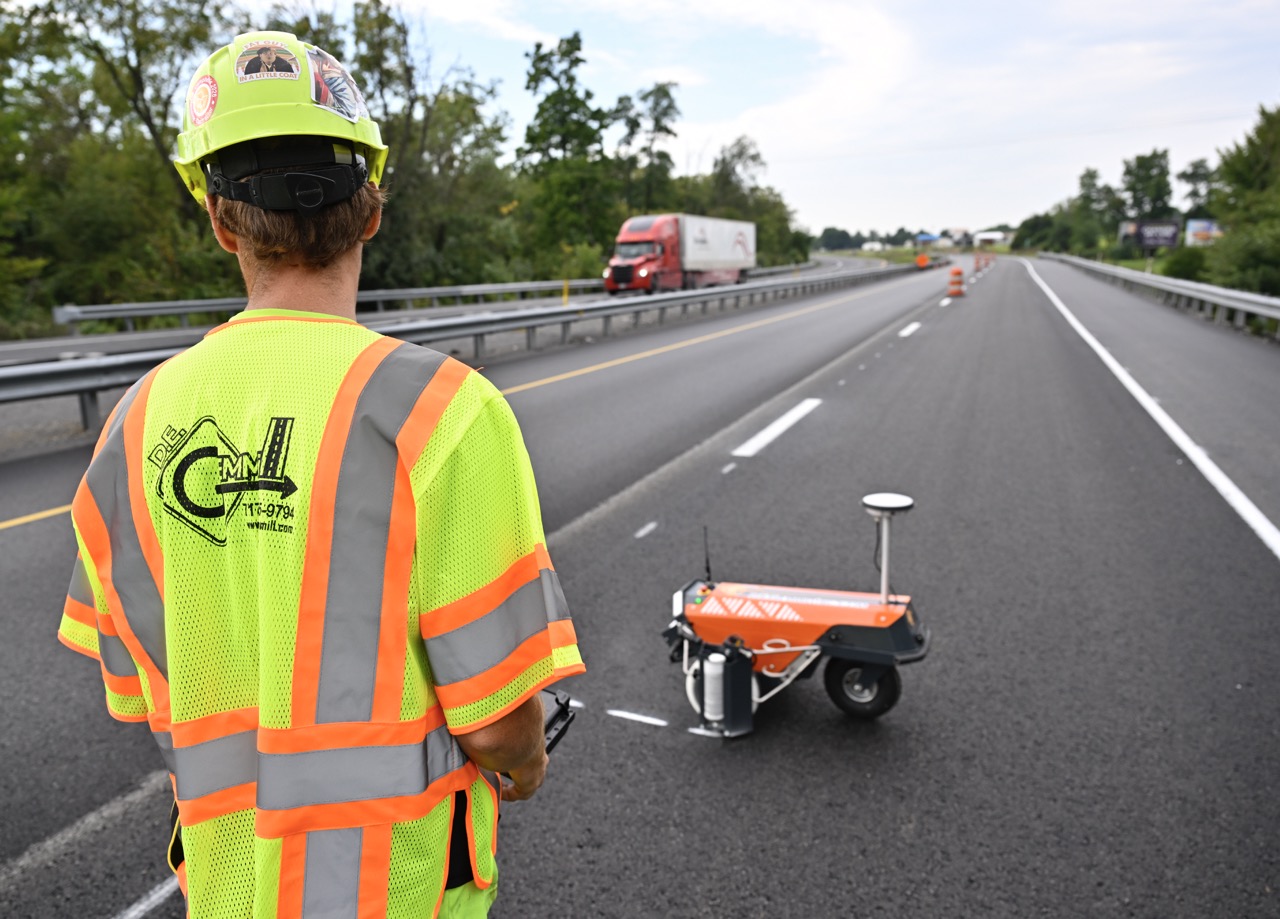

Robotic Layout Technology for Roadway Projects in PA, MD, & DE
CONTRACTING SERVICES
We provide robotic roadway layout services that combine LiDAR roadway mapping with automated field layout. We currently use this process to capture existing transverse joint locations before paving and mark those locations again on the finished pavement for subsequent saw-and-seal work.
By integrating roadway scanning, positioning data, and robotic layout, we can reduce manual layout tasks, limit the time our crews spend physically on the roadway, and move more efficiently through the layout phase of your project.
Transverse-joint layout is our first application for robotic roadway layout technology. We use this process to carry the locations of existing concrete joints through milling and paving so those positions can be marked on the new pavement surface.
This approach reduces the manual effort traditionally required to locate and mark transverse joint positions on the roadway.
We integrate LiDAR roadway scanning, data processing, and automated field layout into a single workflow that carries positioning information from the existing roadway to the finished pavement.
1. Capture Existing Joint Locations
After crews mill the existing asphalt and expose the underlying concrete roadway, we use our Auto Layout truck and LiDAR technology to scan and capture the locations of the existing concrete joints.
2. Process the Positioning Data
Clearly defined lanes and designated parking areas prevent accidents caused by confusion or unclear traffic flow.
3. Mark the New Pavement
After paving, we upload the positioning data to the Tyker Robotic Plotter. Tyker travels the new pavement surface and marks the transverse joint locations required for the subsequent saw-and-seal operation.
See how the Tyker Robotic Plotter supports our roadway layout process in the field.
Reduced Roadway Exposure: We can reduce the amount of time multiple employees need to spend physically walking and marking the roadway during layout.
More Efficient Layout: Automating portions of the process can reduce the time and crew resources required for traditional manual layout on your roadway project.
Reduced Physical Demands:
Robotic layout can reduce repetitive bending and other physical demands associated with manually locating and marking roadway positions.
Directional arrows: We carry LiDAR-captured positioning data into the robotic field layout process, creating a more streamlined workflow from data collection to final pavement layout.
Our robotic roadway layout service is currently used on projects where existing concrete joint locations need to be captured before paving and re-established on the finished pavement surface.
The service can support:
Roadway milling and resurfacing:
Capture the locations of exposed concrete joints before new pavement is placed.
Transverse-joint layout:
Re-establish existing joint positions on the newly paved roadway surface.
Saw-and-seal preparation:
Mark the joint locations needed for the subsequent saw-and-seal operation.
Joint-location transfer:
Carry LiDAR-based positioning data from the pre-paving roadway scan through final field layout.
For projects that also require pavement marking, learn more about our highway pavement marking services.
“D.E. Gemmill is the first company in the U.S. to utilize this technology for transverse-joint layout, demonstrating a new application for robotic layout in roadway construction.”
Alex Coyle, Director of Geospatial Solutions, SOLO GS
We’re the first company in the United States to use the Tyker Robotic Plotter for transverse-joint layout. We’re also among fewer than 10 U.S. companies currently implementing this autonomous layout technology.
Our investment in robotic layout reflects our broader approach to using technology to improve roadway safety, efficiency, and project capabilities.
We’ve served the roadway industry since 1986. Today, our Pavement Marking & Maintenance Division provides pavement marking and maintenance, hydroblasting and marking removal, Auto Layout with LiDAR technology, robotic layout, sign installation, and roadway safety services throughout Pennsylvania, Maryland, and Delaware.
Improved customer satisfaction:
A well-organized parking lot with clear markings reduces confusion and frustration for customers, leading to a more positive experience.
Enhanced Safety:
Clearly designated pedestrian walkways, accessible parking spaces, and fire lane markings minimize the risk of accidents and ensure compliance with safety regulations.
Increased efficiency:
Proper striping optimizes parking space usage, reduces congestion, and improves traffic flow
within the parking lot.
Boosted curb appeal:
Freshly painted and well-maintained stripes project a professional image for your business and contribute to a positive first impression.
Robotic layout introduces a new approach to work that has traditionally required significant time and physical labor on the roadway. Here are a few things to know about how we’re using Tyker technology.
We currently use robotic layout when transverse joint locations need to be captured before paving and then marked again on the finished pavement for subsequent saw-and-seal work.
No. We use the technologies together. LiDAR captures existing joint locations and provides the positioning data we need before the robotic system marks those locations on the newly paved surface.
No. The robotic layout system marks the transverse joint locations required for the subsequent saw-and-seal operation.
Yes. Automating portions of the layout process can reduce the amount of time multiple employees need to spend physically on the roadway. As we expand our use of the technology, operators will also be able to control the robot from a vehicle, further reducing personnel exposure to traffic.
We combine LiDAR roadway mapping with Tyker robotic layout technology to support transverse-joint layout and saw-and-seal preparation while reducing manual roadway exposure. Contact our team to discuss your project and learn more about our robotic roadway layout services in Pennsylvania, Maryland, Delaware, and throughout the Mid-Atlantic.
When you choose D.E. Gemmill for your parking lot striping needs, you can trust that we’ll work closely with you to assess the feasibility and cost-effectiveness of your project, ensuring a seamless and satisfactory experience from start to finish.